|
Sigmund
Freud
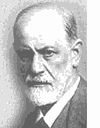 Considered
the father of psychoanalysis, Sigmund Freud (1856-1939) revolutionizes the study
of dreams with his work The Interpretation Of Dreams. Freud begins to
analyze dreams in order to understand aspects of personality as they relate to
pathology. He believes that nothing you do occurs by chance; every action
and thought is motivated by your unconscious at some level. In order
to live in a civilized society, you have a tendency to hold back our
urges and repress
our impulses. However, these urges and impulses must be released in some way;
they have a way of coming to the surface in disguised forms. Considered
the father of psychoanalysis, Sigmund Freud (1856-1939) revolutionizes the study
of dreams with his work The Interpretation Of Dreams. Freud begins to
analyze dreams in order to understand aspects of personality as they relate to
pathology. He believes that nothing you do occurs by chance; every action
and thought is motivated by your unconscious at some level. In order
to live in a civilized society, you have a tendency to hold back our
urges and repress
our impulses. However, these urges and impulses must be released in some way;
they have a way of coming to the surface in disguised forms.
One
way these urges and impulses are released is through your dreams. Because the
content of the unconscious may be extremely disturbing or harmful, Freud
believes that the unconscious expresses itself in a symbolic language.
Freud
categorizes aspects of the mind into three parts:
Id
- centered around primal impulses, pleasures, desires, unchecked urges and wish
fulfillment.
Ego
- concerned with the conscious, the rational, the moral and the self-aware
aspect of the mind.
Superego
- the censor for the id, which is also responsible for enforcing the moral codes
of the ego.
When
you are awake, the impulses and desires of the id are suppressed by the superego.
Through dreams, you are able to get a glimpse into your unconscious or the id.
Because your guards are down during the dream state,
your unconscious has the opportunity to act out and express the hidden desires
of the id. However, the desires of the id can, at times, be so disturbing
and even psychologically harmful that a "censor" comes into play and translates
the id's disturbing content into a more acceptable symbolic form. This helps to
preserve sleep and prevent you from waking up shocked at the images. As a
result, confusing and cryptic dream images occur.
According
to Freud, the reason you struggle to remember your dreams, is because the
superego is at work. It is doing its job by protecting the conscious mind from
the disturbing images and desires conjured by the unconscious.
Freud
Topics:
1:
Sigmund Freud Intro
2
Freudian Dream Tools
3.
5 Stages of Personality Development

|