|
Carl
Jung
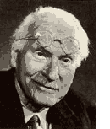 Like
his mentor Sigmund Freud, Carl Gustav Jung (1875-1960) also believes in the
existence of the unconscious. However, he does not see the unconscious as
animalistic, instinctual, or sexual; he sees it as more spiritual.
Eventually, Jung split with Freud due to their differing views on dreams. Like
his mentor Sigmund Freud, Carl Gustav Jung (1875-1960) also believes in the
existence of the unconscious. However, he does not see the unconscious as
animalistic, instinctual, or sexual; he sees it as more spiritual.
Eventually, Jung split with Freud due to their differing views on dreams.
According
to Jung, dreams are a way of communicating and acquainting yourself with the
unconscious. Dreams are not attempts to conceal your true feelings from the
waking mind, but rather they are a window to your unconscious. They serve to
guide the waking self to achieve wholeness and offer a solution to a problem you
are facing in your waking life.
Jung
views the ego as your sense of self and how you portray yourself to the world.
Part of Jung's theory is that all things can be viewed as paired
opposites: good/evil, male/female, or love/hate. So working in opposition to the
ego, is the "counterego" or what he refers to as the shadow. The
shadow represents the rejected aspects of yourself that you do not wish to
acknowledge. The shadow is more primitive, somewhat uncultured, and a
little awkward.
Jung
Topics:
1.
Carl Jung Into
2.
Jungian Dream Interpretation
3.
Carl Jung's Archetypes

|